Days of Slaughter by Susan Wharton Gates
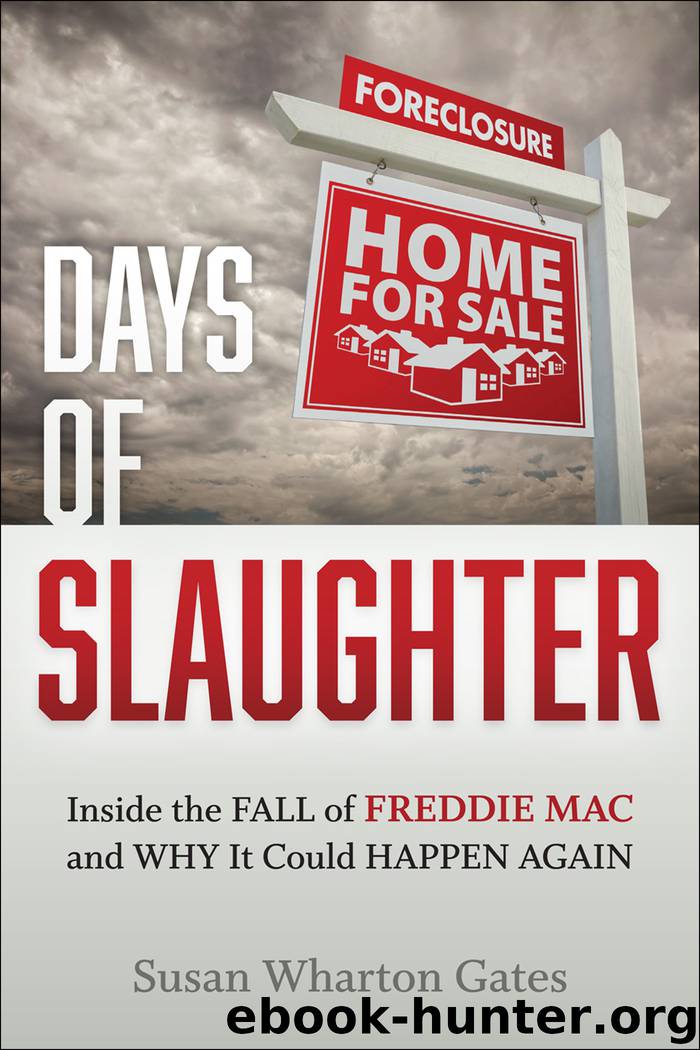
Author:Susan Wharton Gates
Language: eng
Format: epub
Publisher: Johns Hopkins University Press
Published: 2017-06-20T16:00:00+00:00
Enter the States
Frustrated with federal inaction to deal with the growth of subprime, individual states began to take matters into their own hands. North Carolina had been first out of the box in 1999, passing legislation with interest rate and point/fee thresholds tighter than the federal standards of the Federal Reserve. This meant that North Carolina–chartered banks operating within the state were obligated to follow the state’s tighter lending standards; in contrast, federally chartered lending institutions operating in the state were not bound by new requirements, which created competitive issues. The mortgage industry fought the new statute, arguing that it would dry up lending in the state. Despite many dire pronouncements, this did not happen.
North Carolina’s anti–predatory lending legislation was a prelude to stiffer state laws to come. It tightened the definition of what constituted a bad loan but maintained a long-standing legal doctrine known as “holder in due course,” which meant that legal liability remained with the originator and could not flow upstream to the mortgage investor.
Starting with the 2002 Georgia Fair Lending Act (GFLA), that doctrine came under severe challenge. This second-generation anti–predatory lending legislation sought to hold investors liable for the sins of the originators. It was a doctrine known as “strict assignee liability,” and it put a bull’s-eye on Wall Street investors who heretofore been able to provide liquidity to the subprime market with impunity.
GFLA was the first state law to attempt to hold liable the secondary mortgage market—including any bank, GSE, or Wall Street investor—for the origination of predatory loans in the primary mortgage market in that state. In the past, liability for such loans would have remained with the lender that had originated it. Under the doctrine of holder in due course, unless fraud was committed, any subsequent purchaser of the mortgage would have been largely immune from any legal consequences stemming from the origination of a bad loan or loans. GFLA sought to overturn that precedent and dry up the source of liquidity behind the origination of loans deemed to be predatory. Thus, if any mortgage purchaser, such as a GSE, happened to buy a bad loan originated in Georgia, that purchaser could be exposed to the risk of class-action lawsuits.
Because the mortgage market is extremely well integrated nationally, lenders everywhere were alarmed by the new law and threatened to stop doing business in Georgia. They reasoned that foregoing business from the state was preferable to assuming the risk of inadvertently purchasing or investing in a predatory loan, as defined by Georgia, and the significant legal penalties that could result.
Furthermore, the working definition of predatory lending remained alarmingly vague. Programming a “know it when you see it” standard into an automated underwriting system was deeply problematic.
Georgia lawmakers tried to improve the definition of what constituted a predatory loan, but lenders howled that the law was too broad, bringing even good loans into the predatory fold. Another problem was detecting bad loans before they were swallowed up in the massive secondary mortgage market. Thanks
Download
This site does not store any files on its server. We only index and link to content provided by other sites. Please contact the content providers to delete copyright contents if any and email us, we'll remove relevant links or contents immediately.
The Brazilian Economy since the Great Financial Crisis of 20072008 by Philip Arestis Carolina Troncoso Baltar & Daniela Magalhães Prates(373283)
International Integration of the Brazilian Economy by Elias C. Grivoyannis(111686)
The Art of Coaching by Elena Aguilar(53746)
Flexible Working by Dale Gemma;(23368)
How to Stop Living Paycheck to Paycheck by Avery Breyer(19844)
Thinking, Fast and Slow by Kahneman Daniel(12568)
The Acquirer's Multiple: How the Billionaire Contrarians of Deep Value Beat the Market by Tobias Carlisle(12442)
The Radium Girls by Kate Moore(12220)
The Art of Thinking Clearly by Rolf Dobelli(10749)
Hit Refresh by Satya Nadella(9274)
The Compound Effect by Darren Hardy(9182)
Tools of Titans by Timothy Ferriss(8631)
Atomic Habits: Tiny Changes, Remarkable Results by James Clear(8545)
Turbulence by E. J. Noyes(8240)
A Court of Wings and Ruin by Sarah J. Maas(8147)
Change Your Questions, Change Your Life by Marilee Adams(7949)
Nudge - Improving Decisions about Health, Wealth, and Happiness by Thaler Sunstein(7878)
How to Be a Bawse: A Guide to Conquering Life by Lilly Singh(7660)
Win Bigly by Scott Adams(7364)
